
Welcome back to HL&S, where we continue to explore the golden era of advertising campaigns to understand why they captivated audiences, hook, line, and sinker.
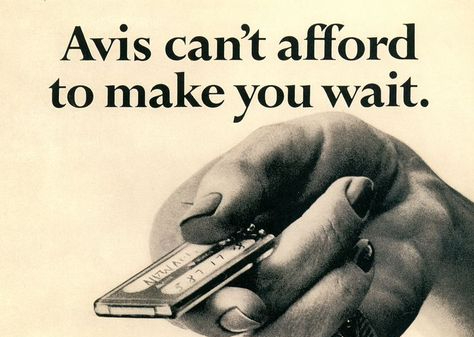
This week, we’re diving into the “We Try Harder” campaign by Avis. Launched in 1962, this campaign was a strategic move that transformed Avis’s position in the car rental market and introduced a powerful example of media planning. Created by Doyle Dane Bernbach (DDB), “We Try Harder” used a carefully planned media strategy to amplify the message, targeting consumers looking for a reliable rental option while setting Avis apart as an underdog with grit and determination. This campaign perfectly illustrates this week’s topic of media planning, covering reach, frequency, and budget efficiency.
The Campaign
When Avis launched this campaign, it was firmly in the number two spot, trailing behind Hertz. Instead of hiding this position, Avis embraced it, positioning itself as the company that worked harder to satisfy customers. With the tagline “We Try Harder,” Avis acknowledged its position in the market, but with a twist: being number two meant that Avis would go above and beyond to earn customer loyalty.


The campaign was primarily executed through print and magazine advertisements, chosen to target a professional audience—particularly business travelers who frequently rented cars. DDB’s media plan focused on placing ads in business publications and travel magazines to directly reach the target demographic.
Media Planning: Optimizing Reach and Frequency
Avis’s media strategy was carefully crafted to maximize reach and frequency while staying within a budget. The campaign’s goal was not only to communicate Avis’s dedication to customer service but also to sustain visibility and reinforce brand recall among business travelers, a key segment in the rental car industry.
In terms of reach, the campaign chose business-centric magazines and travel publications that had high circulation among professionals, ensuring that Avis’s message was seen by a broad audience within the target market. By focusing on publications read by frequent travelers, Avis was able to capture a significant portion of its desired audience efficiently (Matejko, 2024).
Frequency was another crucial component. To ensure consistent exposure, Avis’s ads appeared in multiple issues of popular business magazines, creating a sustained presence and reinforcing the message. By maintaining a high frequency in a select number of publications, Avis built familiarity and trust with its audience, which was essential for gaining a loyal customer base (Marketing Evolution, 2022).
Budget Efficiency: Strategic Media Choices
One of the most impressive aspects of this campaign’s media plan was its cost-effective approach. Instead of spreading ads across multiple types of media, Avis concentrated its budget on print ads in highly relevant publications. This strategy maximized the campaign’s impact while keeping costs low, a smart move for a brand with limited resources compared to Hertz (Pych, 2023).
Avis also benefited from the cost efficiency of print media, which allowed for repeated ad placements without the higher costs associated with television. By focusing on print, Avis was able to invest in quality placements that would yield the highest return in terms of reach and engagement.
Key Takeaway: Leveraging Media Planning for Competitive Advantage
This week’s lecture emphasized the role of media planning in creating effective campaigns, especially for brands looking to make the most of their resources. Avis’s “We Try Harder” campaign demonstrates how a focused media plan can amplify a brand’s message and drive meaningful engagement with the target audience. By choosing the right publications and optimizing reach and frequency, Avis was able to punch above its weight and compete with the market leader (The Denver Post, 2016).
The campaign also highlights the importance of aligning media choices with brand values and audience expectations. Avis’s decision to concentrate on business publications allowed it to reach its ideal customer base with precision, demonstrating how well-executed media planning can create a lasting impact.
Critical Reflection: Is Less More in Media Planning?
Reflecting on this campaign, it’s clear that less can indeed be more in media planning. By narrowing its media focus, Avis was able to achieve a high reach and frequency without overspending. This strategy might seem risky to modern marketers, who are often encouraged to diversify across digital platforms. However, Avis’s focused approach shows that strategic media choices can drive strong results even on a limited budget (The Denver Post, 2016).
The “We Try Harder” campaign also raises an interesting question for marketers today: Is it better to saturate a smaller audience segment or spread the budget thinly across a broader one? Avis’s success with its targeted approach suggests that depth can be more valuable than breadth, especially when brand loyalty is at stake.
Final Thoughts:
In conclusion, Avis’s “We Try Harder” campaign serves as a powerful example of the impact of thoughtful media planning. By optimizing reach and frequency in a targeted way, Avis was able to communicate its brand values effectively and resonate with a key audience segment. This campaign proves that media planning is not just about spreading the message—it’s about delivering it to the right people in the most efficient way possible.
What do you think? Did Avis’s focused media strategy reel you in, Hook, Line, & Sinker? Let me know in the comments below!
Join me next time as we continue our journey through the golden age of advertising and the strategies that made these campaigns unforgettable.
References:
Marketing Evolution. (2022, August 31). Media planning: A complete guide for marketers. Marketing Evolution. https://www.marketingevolution.com/marketing-essentials/media-planning
Matejko, S. (2024, October 30). How to create a media plan in 10 steps. Semrush. https://www.semrush.com/blog/media-planning/
Pych, J. (2023, October 10). Media planning basics: The 10 parts of a media plan. Bionic Advertising Systems. https://www.bionic-ads.com/media-planning/media-plan/
The Denver Post. (2016, April 29). ‘We try harder’: The story of most brilliant ad slogan of the 20th century. The Denver Post. https://www.denverpost.com/2013/08/13/we-try-harder-the-story-of-most-brilliant-ad-slogan-of-the-20th-century/
Swipe File. (n.d.). Avis: “We’re only number 2” ad campaign. Swipe File. https://swipefile.com/avis-were-only-number-2-ad-campaign/
Swipe File. (n.d.). Avis: “We’re only number 2” ad campaign. Swipe File. https://swipefile.com/avis-were-only-number-2-ad-campaign/
Pinterest. (n.d.). Avis “We try harder” campaign. Pinterest. https://ca.pinterest.com/pin/34199278397229299/
Tonic Consultancy. (2023, November 14). Avis: “We try harder” branding for underdogs. Tonic Consultancy. https://www.tonicconsultancy.co.uk/2023/11/14/avis-we-try-harder-branding-for-underdogs/
Niagara Gazette. (n.d.). “We try harder”: The most brilliant ad slogan of the 20th century. Niagara Gazette. https://www.niagara-gazette.com/archives/we-try-harder-the-most-brilliant-ad-slogan-of-the-20th-century/article_9f8e6de9-b4f6-5b03-8d84-82b4370ad940.html
 HL&S
HL&S 
Leave a comment