
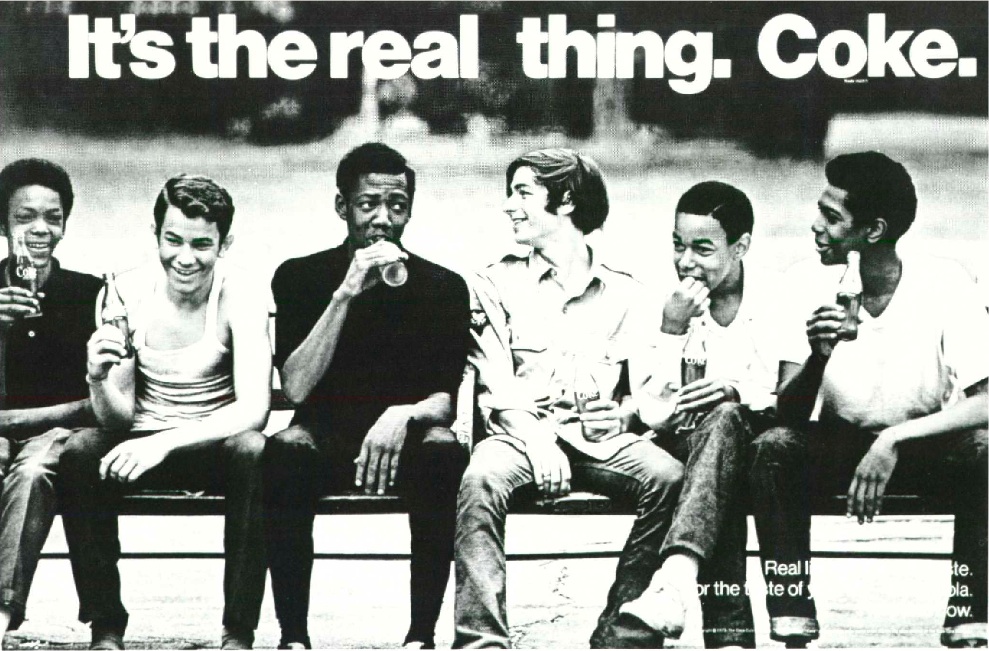
Welcome back to HL&S, we’re diving back into the lost art of classic advertisements from the golden era to understand, why did consumers eat them up, Hook, Line, & Sinker.
This week, we’re going over one of my personal favourites, Coca-Cola’s famous, “It’s the Real Thing” campaign from 1971. In addition to my personal admiration for this campaign, it also highlights this week’s topic, Advertising Strategy: Positioning, and Creative Briefs. We’ll use the “It’s the Real Thing” campaign and its development to better understand it’s approach to positioning strategy while also trying to answer some rather significant questions regarding integrated marketing communications (IMC) and brand positioning.


This campaign was Coca-Cola’s way of consolidating the significant changes being made to the brand as it entered the 1970s. Ira C Herbert, Coca-Cola’s Brand Manager at the time, said that this campaign, “responds to research which shows that young people seek the real, the original and the natural as an escape from phoniness.” (Creative Review, n.d.). This campaign was a symbol for the larger rebranding efforts of studio Lippincott & Margulies, which started in the mid-1960s. This was a four year long project and marked the largest ever programme of its kind. From Coca-Cola’s identity and design to its approach to advertising, everything about Coca-Cola was examined. This work culminated in a redefinition of what Coca-Cola as a brand really meant, including new graphics with ‘dynamic contour” design language, meant to reflect the famous shape of a Coke bottle, as well as many other changes to the very core of Coca-Cola as a company. With the rebrand came new TV commercials, which showcased close ups of still imagery, depicting “real life” moments. These were shot by well-known photographers that specialized in the candid aesthetic to reenforce their message.
To really hammer home this focus on depicting reality, the Creative Director of Lippincott & Margulies, Bill Backer, co-wrote a song with songwriter, Roger Cook. That song would become the backbone behind the now iconic, “I’d Like to Buy the World a Coke” advertisement featured in this campaign. The song “I’d Like to Buy the World a Coke” was an adaptation of the song, “I’d Like to Teach the World to Sing”, which prior to this advertisement didn’t perform well (Creative Review, n.d.). Upon release it was an immediate success, the song became incredibly popular, which helped this advertisement become so iconic.
The “I’d Like to Buy the World a Coke” advertisement features a group of young individuals standing on a hilltop in Italy, all from different walks of life, different creeds, and different cultures. Each with a bottle of coke in their hand. They’re all singing along as “I’d Like to Buy the World a Coke” plays, different shots of the group are shown. At the very end, the following text appears on screen to end the commercial:
“On a hilltop in Italy,
We Assembled young people
From all over the world…
To bring you this message
From Coca-Cola Bottlers
All over the world.
It’s the real thing. Coke.” (Coca-Cola, 1971)

This advertisement both, reenforced the objectives of the campaign, by showcasing unity in a way that didn’t come off as fake to reflect the shifts in identify that Coke was going through at the time, and reaffirmed Coke as the original cola. The ladder is very important to Coca-Cola as a brand, not just the campaign; they see their 12 year head start to Pepsi as a major point of difference. This goal is achieved in a creative way by the very last line, “It’s the real thing, Coke” (Creative Review, n.d.).
In short, this campaign positioned Coca-Cola as more than just a drink, it was the real, authentic choice for consumers who desired genuine experiences. This campaign leveraged an emotional positioning strategy, making Coca-Cola a lifestyle choice instead of a product choice. “It’s the Real Thing” highlighted the global appeal of Coke, playing of their existing brand equity to highlight authenticity in a world of limitations. As I mentioned above, this approach was incredibly successful, to the point that the slogan, “It’s the Real Thing”, became synonymous with Coca-Cola itself, solidifying its leadership in the market.
This advertisement was one of the reasons why I fell in love with advertising, it showcased to me advertising ability to act as a microphone to amplify an important message, in this case about unity.
Key Takeaway: The Power of a Creative Brief
In this week’s lecture, we discussed how vital the development of a clear and concise creative brief, it’s essential the backbone of any successful campaign. A creative brief boils down to an important planning document that contains key information about a campaign’s key message (big idea), target audience, and brand positioning that an agency’s creative team uses as scaffolding to build its campaign around (St. Bonaventure University, 2019).
Coca-Cola’s “It’s the Real Thing” campaign highlights the potential power of a creative brief by showing how a clear and concise vision can help build towards a unified and impactful advertising strategy. It’s important to note that this campaign was so successful in its emotional appeal that, “It’s the Real Thing”, actually became Coca-Cola’s slogan.
To better understand the link, I’ll give my own perspective on what would likely be included in a Creative Brief for this campaign, by breaking down this campaign into components that likely were part of its creative brief, we can more easily understand the decisions that contributed to its lasting success:
1.) Brand Positioning: This campaign clearly is aiming to reposition the Coca-Cola brand as authentic, original cola. The brief would contain an outline regarding Coca-Cola’s objective of differentiating themselves as “the real thing” in a market literally saturated by imitators (Because Coke was genuinely the first cola beverage).
2.) Target Audience: It’s clear from the “I’d Like to Buy the World a Coke” advertisement in this campaign that the audience is young individuals from around the world, seeking authenticity. A sidenote to consider is how easy it is to identify each of these aspects, that’s a tell of good advertising.
3.) Big Idea: Undoubtedly the brief is likely to contain the key message of Coca-Cola is the genuine, trusted choice. It’s evident that this is the core message because no matter which advertisement from this campaign you look at, they all come back to this point.


This breakdown should demonstrate how well-crafted creative briefs can help to focus the creative process and help to ensure a cohesive campaign that builds towards a brand’s goals.
Final Thoughts
As I wrap up on this week’s reflection, it’s clear to me that a well thought out creative brief can really elevate a brand, beyond products and services, creating strong emotional connections with your consumers.
With that, I warp up this week’s deep dive! Tell me what you think, did this campaign reel you in, Hook, Line, & Sinker? Comment below!
Join me next time as we continue to explore the lost art of alluring advertising.
References
St. Bonaventure University. (2019, October 22). Why is integrated marketing communications important? Retrieved from https://online.sbu.edu/news/importance-of-integrated-marketing-communications#:~:text=Builds%20Brand%20Recognition%20and%20Trust&text=An%20integrated%20marketing%20communications%20strategy,the%20intended%20message%20will%20translate.
Creative Review. (n.d.). 13: Coca-Cola (1940s) – It’s the Real Thing. Creative Review. https://www.creativereview.co.uk/its-the-real-thing-coca-cola/
Project ReBrief. (2012, March 6). Coca-Cola, 1971 – ‘Hilltop’ | “I’d like to buy the world a Coke”. YouTube. https://www.youtube.com/watch?v=1VM2eLhvsSM
The Coca-Cola Company. (n.d.). “I’d like to buy the world a Coke”. Coca-Cola. https://www.coca-colacompany.com/about-us/history/id-like-to-buy-the-world-a-coke
Fonts in Use. (n.d.). Coca-Cola ad from 1974. Fonts in Use. https://fontsinuse.com/uses/3220/it-s-the-real-thing-coca-cola-ads-1969-74
Scalar. (n.d.). It’s the real thing – Coca-Cola integrated ad. Scalar. https://scalar.usc.edu/works/counter-cola/the-real-thing
Alamy. (n.d.). 1970s USA Coca-Cola magazine advert. Alamy. https://www.alamy.com/stock-photo-1970s-usa-coca-cola-magazine-advert-85327183.html
Alamy. (n.d.). Coca-Cola advert 1970s. Alamy. https://www.alamy.com/stock-photo/coca-cola-advert-1970s.html
Daily Mail. (2015, June 26). The video Coca-Cola DOESN’T want: Iconic 1971 ad stars patients with diabetes, obesity, missing teeth years after glugging drink. Daily Mail. https://www.dailymail.co.uk/health/article-3139178/The-video-Coca-Cola-DOESN-T-want-make-iconic-1971-ad-stars-patients-diabetes-obesity-missing-teeth-years-glugging-drink.html
eBay. (n.d.). Coca-Cola advert from 1971. eBay. https://www.ebay.ph/itm/284887166490
Creative Review. (n.d.). Coca-Cola ad from 1971. Creative Review. https://www.creativereview.co.uk/its-the-real-thing-coca-cola/
eBay. (n.d.). Coca-Cola vintage ad. eBay. https://www.cafr.ebay.ca/itm/363461830303
Reddit. (2013, June 13). Coca-Cola ad July 1970. Reddit. https://www.reddit.com/r/vintageads/comments/1eb4sud/cocacola_july_1970/
 HL&S
HL&S 
Leave a comment